The Land That Was Already Home
Before the story goes anywhere sad, you have to see what was there first. Palestine in the 1800s: olive groves and Jaffa oranges, a land the Qur'an calls blessed, three religions sharing the same streets, and the quiet piece of paperwork that would one day take it all away.
The Nakba — Chapter 1 of 9
The Land That Was Already Home
There is a word you need to learn before we start.
Nakba.
Say it out loud. Nak-ba. It is an Arabic word, and it means catastrophe. Not a small one. Not a bad day. It means the kind of disaster that breaks a whole world into pieces and leaves the pieces on the ground.
For Palestinians, the Nakba is one particular year. 1948.
In that year, somewhere between 750,000 and 800,000 people lost their homes. Not for a week. Forever. More than 500 towns and villages were emptied out, and hundreds of them were knocked flat so that nobody could come back to them. Thousands of people were killed. Families ran with whatever they could carry, and many of them carried the front door key of a house they were certain they would return to in two weeks.
Some of those keys still exist. Grandchildren keep them in drawers. The houses are gone.
That is where this story ends. But a story does not begin at its ending. If anybody tells you the Nakba started in 1948, they are opening the book halfway through. It took about a hundred and fifty years to build, planned in offices in London and Paris and Basel by men who mostly never saw a Palestinian village in their lives.
So we start at the beginning. And the beginning is a place.
What Palestine actually was
Picture a strip of land on the eastern edge of the Mediterranean Sea. Not big. You could drive from the top to the bottom in a day, if you had a car, which almost nobody did.
Most people were farmers. In Arabic, fellahin. They grew wheat and barley and lentils. They kept goats. They pressed olives into oil every autumn, and the olive harvest was the biggest week of the year, when everyone climbed into the trees together and the whole village smelled green.
Some of those olive trees were a thousand years old. A farmer would show you a tree and tell you which great-great-grandfather had planted it.
The villages had a shape to them. Stone houses packed close, a well, a mosque or a church, a threshing floor where the wheat was beaten. Each village had a mukhtar, a chosen elder, who settled arguments and spoke for everyone when the tax collector came.
And there were cities.
Jaffa sat right on the sea, and it was famous across the world for one thing. Oranges. Big, thick-skinned, absurdly sweet oranges that travelled well on ships. If you were in London in 1900 and you ate an orange, there is a decent chance it grew in Jaffa.
Nablus made soap. Olive oil soap, cut into cubes and stacked into tall towers to dry. Haifa was a busy port curled under a mountain. Acre was a walled sea fortress that had beaten off armies for centuries. Gaza was an old trading town on the road to Egypt. Safed sat high in the hills where the air was cold. And Jerusalem was Jerusalem, holy to three religions at once, with the Al-Aqsa Mosque, the Church of the Holy Sepulchre, and the Western Wall all inside the same set of ancient walls.
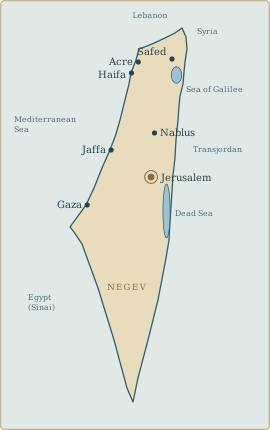
Palestine, and the cities in this chapter. Notice the Negev, the desert filling the southern triangle. It is more than half the land and almost none of the people, which is worth remembering when you get to chapter four and men in London start dividing this country up by percentages.
Who lived there
Palestine was mostly Muslim. It also had a large and old Christian community, Arab Christians whose families had been Christian since before Europe was. Bethlehem, Nazareth, Ramallah and parts of Jerusalem were full of them.
And there were Jews.
Jewish families had lived in Palestine for a very long time, especially in four cities they considered holy: Jerusalem, Hebron, Tiberias and Safed. Around 1840 there were roughly 3,000 of them in the whole country. Mostly religious families who had come to pray and study and be buried in the holy land. They spoke Arabic in the market. They were neighbours.
Remember that number. It comes back.
Three religions, same streets, same water, same tax collector. Was it a perfect paradise? No. Real places never are. There were arguments and bad years. But Muslims, Christians and Jews in Palestine were not enemies. They were people from the same towns, and they went to each other’s weddings.
Altogether, around half a million people lived there.
Hold on to that picture. Because in about eighty years, people in Europe would start describing this exact place, in their newspapers, as “a land without a people.”
A land with a name
So who was in charge of all this?
In the 1800s, Palestine was part of the Ottoman state. This is the part people get wrong most often.
The Ottoman state was the Muslim caliphate. Its Sultan ruled an enormous empire that reached across three continents, and he had a hundred things to answer for. Armies. Taxes. Governors. Harvests.
But one duty was counted above all the others. He was the guardian of the sacred places of Islam. Makkah. Madinah. And Al-Quds, which is the Arabic name for Jerusalem.
So a farmer outside Nablus in 1850 was not living under somebody else’s flag. He was living in Muslim land, under a Muslim ruler. If he had a quarrel with a neighbour, he took it to a Muslim judge, who settled it by Islamic law. That had been true for four hundred years, since 1517.
Here is something you can still go and touch. The great stone walls around the Old City of Jerusalem were built by an Ottoman sultan called Suleiman in the 1530s, and they are standing today. They did not just hold the city. They looked after it.
None of that made it a paradise. Some later governors taxed people hard, and the army took village boys away for years at a time. You will see very soon what that cost.
But this was not a foreign country sitting on top of a conquered people, and that matters.
Palestine was not a nameless patch of ground either. Within a few years of the Muslims arriving in the 630s, this land was organised and given a name. Jund Filastin, the district of Palestine. It had its own capital city, Ramla, built for the job around the year 715. That name sits in the records for thirteen hundred years.
One day somebody will tell you Palestine was never a real country, because it had no flag and no parliament. Europe invented that rule, then used it looking backwards, on a land that had a name, a border, a capital and a people long before most European countries existed.
There is more to it than lines on a map. In the Qur’an this land is called al-Ard al-Mubarakah, the Blessed Land. Al-Aqsa in Jerusalem was the first qiblah, the direction Muslims turned to face when they prayed, before Makkah. It is one of the three sacred mosques.
You do not need a flag to be a place.
Who the land actually belonged to
Here is something strange. Do you know how a village owned its land?
Not the way you might think. Most village land was shared. The Arabic word for it is musha’. The village held its land together and split it between the families, and every few years they swapped the strips around, so no family was stuck forever with the stony corner and no family kept the good soil by the water for three generations running.
It was fair. It was ancient. It worked.
What it was not was written down on paper, the way a European lawyer would want it.
That is how the land was shared out. But what actually made it yours?
In Islam, and in the way those villages actually lived, you do not own land because a clerk wrote your name in a book in a city you have never visited. You own it because your family cleared it, watered it, planted it and worked it. Season after season. Grandfather to father to son. And because your neighbours knew it and agreed.
The Prophet, sallallahu alayhi wa sallam, said that whoever brings dead land back to life, it belongs to him.
So picture a family in the village of Ma’lul. Their grandparents farmed that land, and their grandparents’ grandparents before them.
Did they own it? Completely. Everybody in the village knew it, and that was the only rule anybody there was using.
Then a piece of paper arrived from far away.
In 1858 the Ottoman government brought in a new land law. From now on, land had to be written into a government book, called the tapu, under one person’s name. The reason was tax. If the government knows who owns what, the government can collect.
The villagers were not fools. They knew exactly what a government list was for.
If your name is in the book, the tax man finds you. Worse, the army finds your sons, and the army took boys for years at a time, and plenty of them never came back.
So they dodged it. They put the land in a dead relative’s name. Or the village elder’s name. Or the name of some rich merchant far away in Beirut or Damascus, who was happy to hold it on paper, and who seemed completely harmless.
Frightened farmers, hiding from the tax man in the 1860s, made a small quiet decision.
That decision is the crack that everything else comes through.
The family in Beirut
Now we jump forward, in places more than fifty years, because this is where you finally see what that government book was for.
Meet the Sursocks. A very rich Christian family in Beirut, with a palace, children at school in France, and friends in Istanbul and Paris. They had made their money trading and banking.
In 1872 they bought a huge stretch of land from the Ottoman government. It was called Marj Ibn Amir, English maps call it the Jezreel Valley, and it is some of the best farmland anywhere between Egypt and Turkey. Flat, dark, generous soil. And they got it cheap.
About twenty villages’ worth of land.
Twenty villages with people living in them. Ma’lul was one of them.
The Sursocks never moved there. They never farmed it. Most of them never even saw it. They sent agents instead, to collect rent from families who had been working that land for centuries before the Sursocks had ever heard of the place.
The rent was not money. It was a share of the harvest, taken out of whatever those families managed to grow.
Here is the part that is easy to miss.
For the farmers, that share of the crop was just another tax, and they had been paying taxes to somebody for a thousand years. Nothing felt lost. The same family walked out to the same trees every morning.
So ask a farmer in Ma’lul in 1890 who owned his land, and he would tell you his family did. By every rule his faith and his village knew, he was right.
He was wrong by one rule only, a name in a book in Beirut, in a system his own grandfather had dodged on purpose.
Within his own lifetime, that one exception took everything he had.
In 1910 the Sursocks agreed to sell the land of a village called al-Fula. The buyer was the Jewish National Fund, an organisation set up in Europe to buy land in Palestine and hold on to it forever. You will meet them properly in the next chapter.
One man tried to stop it.
His name was Shukri al-Asali, and he was the Ottoman governor of the Nazareth district. Now remember that government book. For a sale like this to count, an official had to write it into the book. Al-Asali was that official.
He refused.
Then he went to the newspapers. Papers all over the Arab world printed what he said, and what he said was simple.
People live on that land. A family in Beirut cannot sell their homes.
So they moved him. He was given a different job somewhere else, somebody else sat down in his chair, and that man wrote the sale into the book.
Then, between 1921 and 1925, the Sursocks sold nearly all the rest of the valley. The buyers were organisations set up to buy land in Palestine for Jewish settlers.
Not one law was broken. Every piece of paper was correct.
Around 8,000 people, in about 22 villages, were put off that land.
Not in a war. By purchase.
Al-Fula. Ma’lul. Indur. Shatta. Jinjar. Tell al-Shammam. Some of those are now the names of nothing at all.
That is the first time in this story that Palestinians lost their homes in large numbers. It happened decades before anybody fired a shot. It was done with a pen, a signature and a receipt.
The first man to offer somebody else’s country
Now come back with me, all the way back, and this time we are leaving Palestine. Because while those villages were farming, other people across the sea had started talking about them.
The year is 1799. A French general named Napoleon Bonaparte has marched an army into Egypt and then north into Palestine, and he is standing outside the walls of Acre, trying to smash his way in.
He can’t. Acre is holding. Napoleon is stuck, hot, and losing men.
So he tries something else. He issues a letter to the Jews of Asia and Africa, offering them Palestine as a homeland, under French protection, if they will rise up and support him.
Look at what just happened. A French general who does not own this land, has never lived on it, and is losing a battle on it, offers it to a people who mostly are not there, in exchange for help winning that battle.
It didn’t work. Nobody took him up on it. Napoleon lost at Acre and went home.
Go to Acre today and there is one thing left of Napoleon. A statue of him on a hill outside the walls, looking at the city he never managed to get into.
Which is the right monument, when you think about it. A European, standing on a hill, staring at a place that was never his.
But the idea had been put into words for the first time. Palestine as a card a European power could play.
The letter from London
Forty-one years later, a British politician picks the card back up.
His name is Lord Palmerston, and his job is looking after Britain’s business with other countries. In 1840 he writes a letter to Britain’s top man in Istanbul, the Ottoman capital.
His message is to convince the Sultan to let Jews from Europe come and settle in Palestine.
Why? Was Palmerston lying awake at night worrying about Jewish suffering?
No. Britain had a problem, and the problem was Egypt.
A ruler there called Muhammad Ali was getting strong and taking more and more land. Britain wanted somebody of its own in the middle of that region, somebody who would always be on Britain’s side.
There was a second reason too. Britain ruled India in those days, and India was the richest land Britain had. The fastest way to travel there from London went right past this coast, and Britain wanted friendly eyes watching that road.
So that was Palmerston’s plan. Bring Jews from Europe to Palestine. They would arrive as strangers, they would need Britain to look after them, and Britain would end up with loyal friends sitting exactly where it wanted them.
Now remember the number. Three thousand Jews in all of Palestine, in a country of half a million.
Palmerston was not trying to help people who already lived there. He was planning to bring them.
That was the reason. Not kindness.
Keep an eye out for this, because it happens over and over. Powerful countries in Europe kept making promises about Palestine, and every single time they were really thinking about themselves.
The part nobody should skip
There is another half to this story, and leaving it out would be dishonest.
While Palestinian farmers were picking olives, Jews in Europe were being hunted.
That is not an exaggeration. For hundreds of years Christian Europe shut Jews into walled corners of cities, banned them from owning land, blamed them when plagues came, threw them out of whole kingdoms, and killed them in mobs. In Russia in the 1880s came the pogroms, organised attacks where Jewish villages were burned and families killed while the police stood and watched. Thousands ran with nothing.
In France in 1894, a Jewish army officer was found guilty of a crime he had not committed, and crowds in Paris screamed for Jewish blood.
So when Jews in Europe began asking where on earth they could be safe, the question was real. It came from a wound that had been bleeding for a thousand years.
Now hold two things in your head at the same time, because this is the hardest idea in the book.
That wound was real. And Palestinians did not cause it.
Not one farmer in Palestine ever burned a Jewish village. Not one of them sat on that jury in France. The people who hurt Jews for a thousand years were Europeans.
But when Europe finally decided to fix the problem it had made, it sent the bill to a village in Palestine.
The quiet before
So picture it one more time, before any of this reached the villages.
A land full of people. Villages with names. Trees with owners. Cities that made soap and shipped oranges. A market where a Muslim, a Christian and a Jew argued over the price of lemons in the same language.
Nobody in those villages read European newspapers. Nobody in Nablus knew that in a hall in Switzerland, two hundred men were about to sit down together and make plans for the ground under their feet.
The farmers went out to the trees that autumn, the way they had every autumn.
They had no idea a clock had already started ticking.
It was counting down to 1948.