The Revolt and the Iron Fist
For three years Palestinians rose up against British rule, and Britain crushed them with a thoroughness that is hard to read about. By 1939 the revolt was over, and Palestine had been left leaderless, disarmed and exhausted, exactly nine years before it would need to defend itself.
The Nakba — Chapter 4 of 9
The Revolt and the Iron Fist
Within a week, Palestinians had done something they had never managed before.
They united.
Rival families, rival towns, Muslims and Christians, city merchants and village farmers. All of them agreed on the same thing at the same time, and together they stopped the country.
Ports stopped loading. Taxis stopped driving. Workers walked away from their jobs. In every town people set up committees to keep the strike going, and at Friday prayers the preachers told the crowds to hold firm.
This is called a general strike, which means not one trade but everybody at once. It lasted six months, and it is still one of the longest strikes by a whole people that the world has ever seen.
They were asking for three things, and none of them were complicated. Stop Jewish settlers coming in. Stop the selling of Arab land. Let Palestine have a government chosen by the people who live in it.
In other words: treat us like a country.
What the children were being taught
Picture a seven-year-old sitting at a desk in Nablus, opening her school book.
The lesson that day is about the borders of her country. Palestine, she copies out, has Lebanon and Syria to the north, Transjordan to the east, Egypt to the south, and the sea to the west.
That is a homeland, written down in a school book and taught to small children, more than ten years before 1948.
Some people today say there was never really a Palestinian nation at all. They say Palestinians only started calling themselves that later, after 1948, as a way of arguing against Israel.
But look at the date on that school book. It was printed years before Israel existed. That girl was not arguing with anybody. She was learning the name and the shape of her own country, the way children everywhere learn theirs.
The grown-ups could see what was coming too. One Palestinian newspaper printed a drawing of the Zionist leaders building their new country, brick by brick. Underneath the bricks, holding the whole thing up, was a pile of human skulls.
That was a drawing in a newspaper, meant as a warning. It was about ten years early.
What Britain did about it
Britain’s answer arrived fast and it was not a negotiation.
Soldiers poured in. The order went out that anybody found outside their home after dark could be shot. And then came the punishment that Palestinians remember best, because you could see it from the road.
House demolitions.
If the British thought that a village was helping the fighters, soldiers arrived and blew its houses up.
In June 1936 they did this to the old city of Jaffa.
They did not choose one or two houses. They cleared a wide path from one side of the old city to the other, blowing up every single house along it. Hundreds of homes, gone in a few days.
In its own reports, Britain called this clearing away old buildings to make the city nicer. Everybody in Jaffa knew the truth.
The families came home to a pile of broken stones. Nobody gave them a new house. Nobody gave them any money.
They also used collective punishment, which is the idea that if you cannot find the guilty person you punish everyone near him. Whole villages were fined. Men were taken from their homes and left standing in wire cages in the hot sun. Villagers were tied to the front of army trucks and driven along the roads, so that the fighters would not dare shoot at them.
By the time the strike ended, more than 190 Palestinians had been killed and more than 800 wounded.
In 1936 and 1937 together, British soldiers killed more than a thousand Palestinians. Over those same two years, Britain counted its own dead: 37 British soldiers and policemen. It counted 69 Jews killed as well.
More than a thousand dead on one side. Just over a hundred on the other.
Britain did not only go after the fighters. It went after the newspapers as well. And it went after the women.
Sadhij Nassar wrote for a Haifa newspaper called Al-Carmel. You met that paper in the last chapter. It had been warning Palestinians about all of this since 1908.
Almost everybody in Palestine knew her name.
She joined the strike in 1936, so the British arrested her. They said she had been handing weapons to the fighters. They never had to prove it, because Britain’s new laws let the army lock people up without ever taking them to court.
So that is what they did. They put her in a prison in Bethlehem and left her there for eleven months.
Nobody told her how long she would be kept. There was no date when she would be let out. She simply waited.
The day they let her out she went back to the newspaper, and she ran it herself until the British shut it down in 1944.
In September 1936 Britain made a new rule for the whole country. From now on the army could arrest anybody it liked, for as long as it liked.
The Arab Higher Committee, the group of Palestinian national leaders headed by the Grand Mufti of Jerusalem, was ordered to stop the strike.
Arab kings from the countries nearby sent a message too. They called themselves friends of the Palestinians, and they asked them to stop and to trust Britain to be fair. What they did not mention was that most of those kings leaned on Britain themselves, for their money, their weapons, and sometimes for their thrones.
In October, the strike ended.
Britain was not fair.
The word “transfer”
Instead, Britain sent a team of people to investigate the situation.
A British lord named Peel arrived with his team, listened to everybody, and in July 1937 published a report that changed everything. Arabs and Jews could never live under one government, it said. So Palestine should be cut in two.
Here is the shape of it.
The Jewish state would take Galilee in the north, and the flat farming land along the coast from Haifa down almost as far as Jaffa. The Arab state would be everything else, and it would be joined on to Transjordan next door. And a narrow strip of land around Jerusalem, running west to the sea, would stay British for ever.
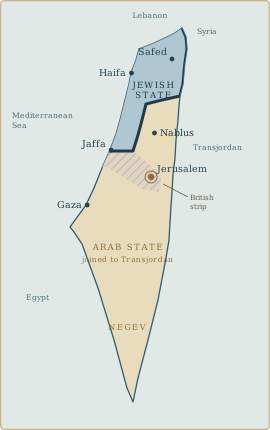
What Britain proposed in July 1937. The bold line is the border of the new Jewish state.
So how big was the Jewish state going to be? You will find two different answers, and both of them are true. Here is why.
Count the whole of Palestine, desert and all, and the Jewish state came to about one fifth of it. But more than half of Palestine is the Negev desert, where almost nobody lived, and Peel gave the Negev to nobody. Leave the empty desert out, count only the land people actually farmed and lived on, and the Jewish state came to about a third of it.
One fifth or one third, then, depending on what you count. What nobody argues about is which part it was. The Jewish state was given the coastline, the ports, the water and the best soil in the country. And it was to be given to a group of people who at that time were only a little over a quarter of everybody living there.
Then the report added one more idea, written in careful, official English. This is the sentence that matters.
It called for a transfer of population. That is a tidy way of saying that the Arabs living inside the new Jewish state would be moved out of their homes and sent somewhere else. The report even counted them. About 225,000 Arabs would have to go. About 1,250 Jews would move the other way.
And if the Arabs would not go of their own free will, the report said, they might have to be moved by force. As an example worth copying, it pointed at Greece and Turkey, who in 1923 had forced well over a million people to swap countries whether they wanted to or not. Anybody who knew how that had really gone knew it was a terrible thing to hold up as a model.
So there it was, printed and signed by the British government in 1937. A quarter of a million people should be taken out of their homes. Not because they had done anything wrong. Only because their homes stood on land that somebody else had been promised.
Palestinians said no to the whole plan. The Zionist leaders argued among themselves about it, and Ben-Gurion wrote privately what he thought: take the state now, even a small one, and worry about the borders later.
From that day the word transfer was part of the plan. It never went away.
Round two, and this one was war
In autumn 1937 the revolt came back, and this time the fighters had guns.
The British governor of the Galilee district was shot dead. Britain answered by banning the Arab Higher Committee and arresting its members. Five of them were put on a ship and sent to the Seychelles, a group of small islands four thousand kilometres away in the Indian Ocean.
One of those five men kept a diary on the island. By 1938 he had worked it out. Britain and the Zionist leaders wanted the same ending, he wrote, and Palestine would be lost while its own leaders were still waiting politely to be listened to.
Nobody who could have done anything about it ever read a word of it.
The Grand Mufti escaped to Lebanon in disguise.
So the Palestinians went into the biggest fight of their lives with their whole leadership locked up, sent away, or in hiding. That was not bad luck. That was the plan.
What followed was a real war in the countryside. The fighters were villagers, mostly farmers with old rifles, and they took control of large parts of it. In 1938 the rebels were the ones running the hill country, and for several days they held the Old City of Jerusalem. British rule in some districts simply stopped working at all.
Many of the fighters called themselves the Qassamiyyun, the men of al-Qassam, after the preacher who had been killed in the hills three years before. They were not fighting for a political party. They believed they were defending the Blessed Land, and that a man who died doing it died a shaheed.
The commanders became famous, and most of them are buried young.
Abd al-Rahim al-Hajj Muhammad led them all. He was a farmer’s son, and even the British respected him, because he refused to attack people who were not fighting. Just before he died he sent a warning to his own side. The politicians are busy arguing among themselves, he said, and that will destroy us from the inside. British soldiers surrounded him and killed him in March 1939.
Somebody took a photograph of his four sons afterwards. Four boys in a row, all of them small.
That is the part of the cost that never gets counted. Every one of these commanders was somebody’s father. The families they left behind were farming families. No money was coming, and there was no government anywhere they could go to for help.
Farhan al-Sa’di was the old man of the revolt, one of al-Qassam’s own followers from the hills near Jenin. He was about eighty years old when British soldiers caught him carrying a rifle. Britain had just made a new law. Anybody found with a weapon could be hanged. His trial took a few days.
They hanged him on 22 November 1937. It was the middle of Ramadan and he was fasting. He asked to be allowed to eat something first.
They hanged him anyway.
An eighty-year-old man, fasting in Ramadan, put to death by a foreign government for owning a gun in his own country. Whatever Britain thought that rope was going to buy, what it bought was a thousand new fighters.
Two of the commanders lived through this war, and you will meet them both again. Hassan Salama led the fighters along the coast, around Jaffa. Abd al-Qadir al-Husseini led them around Jerusalem. In 1948 they are back, fighting over exactly the same ground.
The third gun
So far this chapter has had two sides shooting. The British soldiers, and the Palestinian fighters.
There was a third.
The Irgun was an armed Jewish group in Palestine. Their rule was simple. Whenever Arabs attacked Jews, they would hit back harder, and they did not mind much who they hit.
In July 1938 they showed what that meant. They did not attack soldiers. They did not attack police stations. They left bombs in the places where ordinary people stand close together. The Arab market in Haifa on 6 July. Haifa again on 25 July. Jerusalem in the same weeks.
In that one month they killed about 68 Palestinians. Shoppers. Porters. Market traders. Children sent out to buy vegetables.
Nothing like this had ever happened in Palestine before. Bombs, in a crowd, on purpose.
It did not stop the revolt. What it did was show everybody what the next thirty years were going to look like.
The iron fist closes
Britain sent in about 25,000 to 30,000 soldiers, and war planes as well. For a country that small, that is an enormous army. Their job was to finish the revolt off permanently.
Fighters had been crossing the northern border from Syria and Lebanon, bringing weapons in with them. So Britain shut that border. A long fence of barbed wire, and mines buried in the ground along it.
Then it began filling the camps. Around 9,000 Palestinians were locked up without any trial at all. No judge, nobody to speak for them, nobody even deciding whether they had done anything wrong. They were simply taken, and held. Soldiers also blew up around 2,000 homes over the three years.
And for any village they suspected of hiding fighters, there was a routine.
Soldiers surrounded it before sunrise. Everybody was driven out into the open, and the men were kept standing there for hours, sometimes for days. The soldiers went through every single house. They took the family’s food, killed the animals, poured the olive oil out onto the ground, and mixed sand into the flour so that nobody could eat it.
Ruining the food was not a search for weapons. It was a punishment for the whole village, and hunger does not care who is guilty.
They also began making Palestinian prisoners walk in front of the army trucks, along roads where mines might be buried.
Then Britain got help from somewhere nobody expected.
The other way to break a revolt
Britain had one more way of fighting, and this one needed no soldiers at all.
If you cannot beat people who are standing together, you can try to stop them standing together.
Palestinians were not one single group. They were villages and towns, farmers and merchants, and a few big families who had been rivals for generations, each one wanting to be the family that spoke for Palestine.
Britain knew all of this. So it paid to pull them apart.
A British official based in Syria went looking for the commanders who had escaped over the border, and made them an offer. Come back, and everything you have done will be forgiven. You will be given weapons. And you will be paid.
The pay was the part that worked. A fighter in the revolt earned about four pounds a month, when there was any money at all. Britain offered six.
Out of that came the peace bands. That was the name Britain gave them, and there was nothing peaceful about them. They were Palestinian fighters, carrying British guns, paid with British money, sent out to hunt down other Palestinians.
The men who joined the peace bands were not all the same. Some really had been rebel commanders, fighting the British, until they stopped and began working for them instead, taking their own fighters with them. Others had never been fighters at all.
Britain paid whoever it thought would be useful.
Then there were the informers. These were Palestinians who secretly told the British which of their neighbours were fighters. One thing they did is remembered above everything else.
Soldiers would drive into a village and line all the men up outside. In the back of one truck, hidden behind a screen, sat a man from that same village with a hood over his head. And he pointed.
The arrests were not the worst part of it. The worst part was the walk home afterwards, when every man in that village began working out which of his neighbours had been sitting inside the truck.
It worked exactly the way Britain meant it to. By late 1938, Palestinians were killing Palestinians. The fighters held trials of their own and put to death the men who had helped the British. Peace bands used their British rifles to settle old family arguments that had nothing to do with Britain at all.
The men who had led the peace bands were hunted too. Some were shot dead years later, long after the revolt was over.
It was the army that beat the revolt, not the peace bands. But the worst damage the peace bands did was this. They left Palestinians unable to trust each other. And that lasted far longer than the revolt did.
Two rules, one country
Here are two of Britain’s rules. The same years, the same country, the same government writing both of them.
Rule one. A Palestinian caught with a rifle, or with bullets, and sometimes with a single bullet in his pocket, could be put on trial by the army and hanged. A hundred and twelve men were hanged that way. You have already met one of them. The old man who was fasting.
Rule two. From May 1936 onwards, Britain handed out guns to Jewish settlers. Not secretly. Openly, with paperwork, and completely legally. Britain built them a police force of their own, called the Notrim, and gave them rifles, uniforms, armoured cars, training and pay. Britain said the settlements needed to protect themselves.
By the end of the revolt there were around 20,000 armed Jewish police and settlement guards in Palestine, all carrying British weapons, all of it allowed by law.
Twenty thousand men armed by the government. And an eighty-year-old hanged in Ramadan for owning a gun.
Then the revolt ended, and the Notrim did not go away.
You met the Irgun earlier in this chapter. There was a second Jewish armed group as well, far bigger, called the Haganah. Thousands of the men Britain had armed and trained and paid simply joined it, and took everything they had been taught with them.
Ten years later, in 1948, Palestinians would meet those men again.
The captain who taught the lesson
Orde Wingate was a British army officer, and he was not like the others. He believed that building a Jewish state in Palestine was something God wanted, and he decided to help make it happen.
In 1938 he was allowed to try something new. He called it the Special Night Squads. A squad is a small group of soldiers, and these ones went out after dark.
Here is what made them different. Half of each squad was British soldiers. The other half was Jewish fighters from the Haganah, signed up as policemen so that they could serve beside the soldiers and carry British guns, completely legally. About twenty five Haganah men at first, growing to around seventy five.
So British soldiers and Haganah fighters now took their orders from the same officer, in the same room, before going out at night to Palestinian villages.
Wingate’s idea was simple. Stop sitting inside forts waiting to be attacked. Go out first, in the dark, and hit hard.
But what he taught his men was not ordinary soldiering.
He trained them to kill without stopping to think. To make prisoners talk by shooting one man out of every ten. To force sand down villagers’ throats until they were sick. To walk into a village, demand its weapons, and promise to destroy the whole place if the weapons did not appear.
He hated Arabs, and he said so openly.
A British historian who studied these squads called what they did state terrorism, which means a government frightening and hurting ordinary people the way an attacker would. Even one of Britain’s own top generals said Wingate was not right in the head.
An Israeli historian puts it simply. Wingate handed the Haganah a method they could use again and again. Surround a village, take it, empty it of its people, knock it down.
Wingate himself picked out two young Haganah men and trained them at his side. One of them was Moshe Dayan. Ten years later, both of them were commanding an army. They used that same method, on those same villages, on a much bigger scale. Wingate never saw it. He was dead by then.
Britain trained one side of the war that was coming, and took the guns away from the other.
Then Britain left.
The bishop on the Haifa road
One more person, because he does not look like the man most people picture when they think about this fight.
Gregorios Hajjar was an archbishop, which is a senior Christian priest in charge of many churches. His churches were in Akka and Galilee, and he lived in Haifa. Palestinians called him the bishop of the Arabs, and they meant all the Arabs, because Muslims came to him for help as well as Christians.
For years he stood up in church and said it openly. British rule was wrong. Letting the Zionists take more and more of Palestine was wrong. He was saying this at a time when Britain was hanging men for owning a gun.
Britain never touched him. It could not put an archbishop in prison without a trial, because Catholics all over Europe would have been furious.
Then, in 1940, his car came off the road on the way to Haifa, and he was killed.
The police said it was an accident. Very few Palestinians believed that, and even the local police wrote down that people were suspicious. Nothing was ever proved. Nothing is being proved here either.
But there is something in this story that needs no proving.
The revolt was never a Muslim uprising. Christians helped lead it, paid for it, wrote for it, preached for it and died in it, and one of its loudest voices belonged to an archbishop. Later on, people started calling this a religious war, Muslims against Jews. It never was. It was Palestinians, Muslims and Christians side by side, trying to keep their own country. The religious story came afterwards, and it suited the people who told it.
The bill
By 1939 the revolt was over.
Here is what those three years cost the Palestinians, and it is the reason 1948 went the way it did.
About 5,000 Palestinians were killed. About 15,000 were wounded. About 5,600 were put in prison. Now picture ten grown Palestinian men standing together. By 1939, at least one of them, and in some places two or three, had been killed, wounded, locked up, or forced out of the country.
Now the other side. Around 400 Jews were killed. Britain lost 262 men, soldiers and police together, and only about a hundred of those were soldiers.
Five thousand Palestinians. Four hundred Jews. Two hundred and sixty-two British.
That is not two armies fighting each other. That is what a modern army does to farmers.
The leaders were gone, scattered across three continents. The fighters were dead, or in prison camps. The guns had been taken away. The villages had no money left.
Meanwhile the Haganah had spent those same three years doing the opposite. Growing. Collecting weapons. Training with British officers. Learning every road and hill in the country.
The paper that came too late
In May 1939 another huge war was about to begin in Europe, and Britain knew it was going to need the Arab world on its side. All of a sudden, Britain cared very much what Arabs thought of it.
So it made a new set of promises and printed them in a book with a plain white cover. Everybody called it the White Paper.
It promised three things.
One. Only 75,000 more Jewish settlers could come in over the next five years. After that, none at all unless the Arabs agreed.
Two. Selling Arab land to Jewish buyers would be stopped in most of the country.
Three. Within ten years, Palestine would become a free country of its own, run by Arabs and Jews together.
That was almost exactly what the Palestinians had been asking for in 1936.
They said no.
Their leaders were scattered across other countries by then, cut off from their own people, and they had stopped believing a single word Britain said. People still argue about that refusal today. Palestinian historians themselves call it one of the worst mistakes in this whole story.
The Zionist leaders were furious. Ben-Gurion answered with a line that turned out to describe the next six years exactly. Jews would help Britain fight Hitler as if the White Paper did not exist, and fight the White Paper as if the war did not exist.
Then Hitler invaded Poland, and for six years the world stopped looking at Palestine.
When it looked again, everything had changed.